Between Two Beats
A game of boules does not look like an athletic event. It is three hours of standing in the sun, throwing a heavy ball eight metres, and walking after it. Almost nothing about it is strenuous — which is exactly why the physiology is interesting.
The sport that looks like nothing
Pétanque is a game of millimetres played by people who are not visibly working. The throw is one arm, from a standing circle, over six to ten metres. Between throws there is conversation. Nothing about it looks like cardiovascular work. Nobody arrives at a court with a hydration plan, because there is no obvious reason to have one.
And yet the conditions are the ones physiology cares about. It is usually hot. It is usually outdoors and unshaded. It goes on for hours, often through the middle of the afternoon. There is no clock forcing a break, no water station, and no sensation of effort to prompt anyone to drink. The losses are slow and unremarkable — exactly the kind of fluid deficit that can accumulate during prolonged, low-intensity time in the heat.
The question this raises is narrow and worth asking precisely. If a player loses one per cent of body mass over an afternoon — about 0.75 kg in a 75-kilogram adult, used here as a rough proxy for net fluid loss — what has changed by the time they step into the circle for the last end?
What one per cent costs
There is a figure that circulates for this: three to five extra heartbeats a minute for every one per cent of body mass lost as water. There is a real number underneath it, and the real number is more interesting than the slogan.
In 1992 Scott Montain and Edward Coyle had eight trained cyclists ride for two hours at 62 to 67 per cent of maximal oxygen uptake in a warm room — 33 degrees, 50 per cent humidity — while drinking four different volumes of fluid. The result was a set of graded deficits, from 1.1 to 4.2 per cent of body mass, and a strikingly linear set of consequences. The more water the riders had lost, the higher their core temperature, the higher their heart rate, and the lower their stroke volume. The relationships were close to straight lines.
Pooling that literature gives a figure rather than a slogan. A 2014 systematic review of exercise in the heat found a mean rise of about three beats a minute for every one per cent of body mass lost — around four in trials held at a fixed intensity, and around one where the intensity was allowed to vary. Every study it included involved heat above 26.5 degrees and deficits of at least two per cent.
So the number describes people exercising, in heat, at deficits larger than the one in question. A boules player is not that. The mechanism is general — less plasma volume, less blood returning to the heart, a smaller stroke, more strokes to compensate — but the magnitude at low intensity has not been measured on a boules court, and nobody should pretend otherwise.
What travels more safely is the direction, and the field evidence is clean. In a study of trail runners in the heat where finishing time was held constant, every additional one per cent of body mass lost was associated with about 0.22 degrees more core temperature and six extra beats a minute. By the end of the run the more dehydrated condition was roughly half a degree warmer and about fifteen beats a minute faster. Same pace, same course, different cost.
Why the heart speeds up
The chain is mechanical. Sweat is drawn in part from plasma, so as it leaves, the circulating volume falls. Less blood returns to the heart between beats, so each beat ejects less. As stroke volume falls, heart rate rises to help defend cardiac output. The extra beats are part of the compensation for a smaller volume ejected with each beat.
Heat complicates it further, because the skin and the muscles are asking for the same blood. Warm skin needs flow to shed heat; working muscle needs flow to receive oxygen. With a reduced circulating volume, satisfying both demands becomes harder. Work on endurance athletes exercising in the heat found that dehydration and hyperthermia each lowered stroke volume by about eleven millilitres per beat on their own — but when the two were combined, the fall was twenty-six millilitres, and cardiac output dropped by thirteen per cent. The two stresses compound each other.
A one per cent body-mass loss from fluid deficit is generally a mild degree of hypohydration in a healthy adult; by itself it does not establish danger or impairment. The point is smaller and more precise: the cardiovascular system is quietly paying more for the same external task. Whether that extra cost matters to precision is the question the next evidence can only partly answer.
The pace does not change. The price of it does.
The heartbeat is also movement
In sports where a projectile leaves the hand or the barrel at a chosen instant, the heart is not only a pump. It is a source of movement in the body holding the aim.
Rifle shooting is where this has been studied. In 1987 a Finnish group recorded the trigger finger, the cardiac cycle and the movement of the gun in six national champions and three beginners. The champions released the trigger during diastole, the interval between the pressure pulses. The beginners fired in both phases, and shot better when they happened to fire in diastole. Tracking the two signals together, the researchers saw the gun destabilised about two hundred milliseconds after each R-wave — the moment the arterial pressure wave arrives.
The literature has since become less tidy, as literatures do. A 2003 study of twenty non-elite air-rifle shooters found triggering concentrated in the early part of the cardiac interval rather than neatly in diastole, and concluded that the simple systole–diastole division is too coarse to describe the effect. It also found that the length of the interval — the heart rate itself — did not change the relationship between where in the cycle a shot fell and how good it was.
So the honest version is this. The cardiac cycle can measurably perturb a held aim, and some groups of shooters show non-random trigger timing within it. But the optimal phase is not consistent across studies — a 2007 study of junior elite shooters did not find that where in the cycle a shot fell determined how good it was — and heart rate itself has not been shown to determine accuracy. Whether any of this matters to a boules throw has never been tested.
Who is actually on the court
There is a second reason this sport is worth singling out, and it has nothing to do with the throw. These games are widely accessible to older players, which makes age-related thirst worth considering.
The classic demonstration is now four decades old and very small: seven healthy men aged 67 to 75 and seven aged 20 to 31, deprived of water for twenty-four hours. Both groups lost a similar amount of body mass. But the older men showed larger rises in plasma osmolality and sodium, reported less thirst, and drank less when water was restored.
That result does not make anyone fragile, and it should not be turned into a rule about individuals. Thirst remains useful; what changes is that the absence of thirst becomes less reassuring with age. Laboratory studies show a blunted thirst response in older adults. How large that difference is during light outdoor sport, in healthy older people, is less certain than the finding is often made to sound.
Playing the long afternoon
The practical conclusion is unglamorous, and deliberately not a prescription. For most healthy players the safest general principle is not to force fixed large volumes: prolonged overdrinking carries its own risk, and the guidance on exercise-associated hyponatraemia supports thirst-guided intake. Older players complicate that rule, because thirst may be blunted. Deliberate opportunities to drink — a jug in the shade, a habit at the change of ends — may therefore be useful, but the amount still has to be individual rather than set by a universal schedule.
Shade between ends does more than comfort: it lowers the skin-blood-flow demand that competes with everything else. Some of the players most likely to benefit from a plan may also be less strongly prompted by thirst.
What the game actually asks
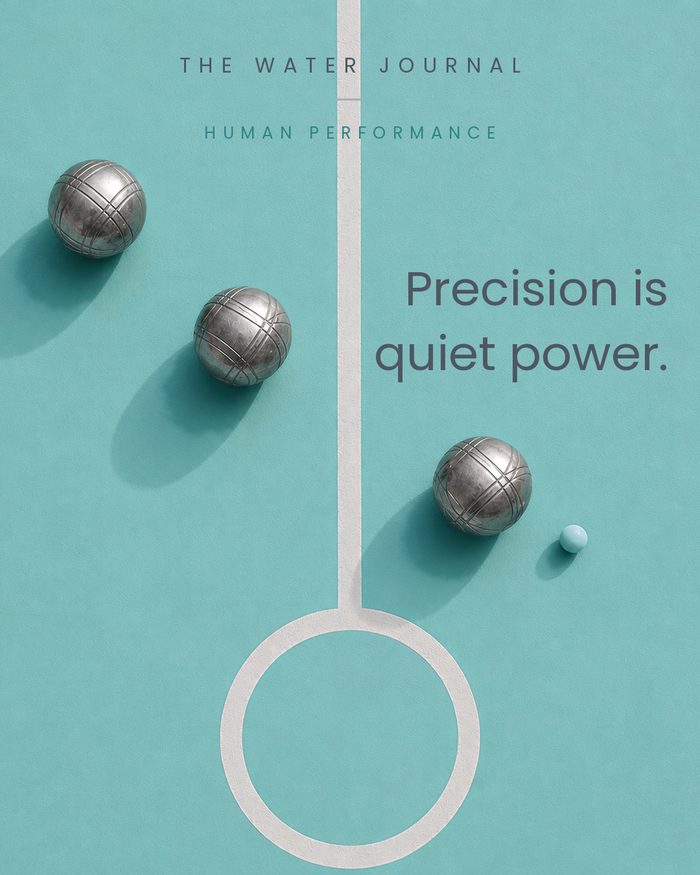
The cover of this issue calls precision quiet power, which is a fair description of the sport and a fair description of the physiology underneath it. Nothing in a game of boules looks like exertion. The circulatory system spends the afternoon making sure it stays that way.
A player who finishes a hot afternoon around one per cent down may feel entirely normal. Exercise studies suggest that fluid loss in heat can increase cardiovascular and thermal cost before the change becomes obvious — but the size of that effect at pétanque intensity has never been measured.
Precision sports are where small physiological costs might matter most — and, in pétanque, where the decisive experiment has not yet been done. That is the argument for taking the least athletic-looking game on the square more seriously than it takes itself.
Sources and notes
01 — The cardiovascular cost
W. M. Adams, E. M. Ferraro, R. A. Huggins and D. J. Casa, "Influence of body mass loss on changes in heart rate during exercise in the heat: a systematic review," Journal of Strength and Conditioning Research, vol. 28, no. 8 (2014), pp. 2380–2389. — twenty studies; mean rise of 3 beats/min per 1% body-mass loss, 4 in fixed-intensity and 1 in variable-intensity trials; included trials required heat above 26.5 °C and deficits of at least 2%.
S. J. Montain and E. F. Coyle, "Influence of graded dehydration on hyperthermia and cardiovascular drift during exercise," Journal of Applied Physiology, vol. 73, no. 4 (1992), pp. 1340–1350. — eight trained cyclists, two hours at 62–67% of maximal oxygen uptake at 33 °C and 50% relative humidity; deficits of 1.1–4.2% body mass; near-linear relationships with core temperature, heart rate and stroke volume. The classic graded experiment, cited here for those relationships rather than for a per-1% coefficient.
J. González-Alonso, R. Mora-Rodríguez, P. R. Below and E. F. Coyle, "Dehydration markedly impairs cardiovascular function in hyperthermic endurance athletes during exercise," Journal of Applied Physiology, vol. 82, no. 4 (1997), pp. 1229–1236. — stroke volume fell about 11 ml/beat for hyperthermia or dehydration alone and 26 ml/beat combined, with cardiac output down 13%.
D. J. Casa et al., "Influence of hydration on physiological function and performance during trail running in the heat," Journal of Athletic Training, vol. 45, no. 2 (2010), pp. 147–156. — field study at matched pace; about 0.22 °C of core-temperature rise and about 6 beats/min per additional 1% of body-mass loss.
M. N. Sawka et al., "American College of Sports Medicine position stand: exercise and fluid replacement," Medicine & Science in Sports & Exercise, vol. 39, no. 2 (2007), pp. 377–390. — guidance recommends avoiding excessive dehydration above about 2% body-mass loss during exercise; not a universal performance threshold.
02 — The aim and the pulse
P. Helin, T. Sihvonen and O. Hänninen, "Timing of the triggering action of shooting in relation to the cardiac cycle," British Journal of Sports Medicine, vol. 21, no. 1 (1987), pp. 33–36. — champions triggered in diastole; the gun was destabilised about 200 ms after the R-wave.
T. Mets, N. Konttinen and H. Lyytinen, "Shot placement within cardiac cycle in junior elite rifle shooters," Psychology of Sport and Exercise, vol. 8 (2007). — no evidence that placement of the shot within the cardiac cycle determined accuracy in this group.
N. Konttinen, T. Mets, H. Lyytinen and M. Paananen, "Timing of triggering in relation to the cardiac cycle in nonelite rifle shooters," Research Quarterly for Exercise and Sport, vol. 74, no. 4 (2003), pp. 395–400. — triggering concentrated in the early cardiac interval; systole–diastole treated as too coarse a division; heart rate itself did not alter the relationship.
03 — Thirst and guidance
P. A. Phillips et al., "Reduced thirst after water deprivation in healthy elderly men," New England Journal of Medicine, vol. 311, no. 12 (1984), pp. 753–759.
T. Hew-Butler et al., "Statement of the Third International Exercise-Associated Hyponatremia Consensus Development Conference, Carlsbad, California, 2015," Clinical Journal of Sport Medicine, vol. 25, no. 4 (2015), pp. 303–320.
Note on evidence
The per-1% heart-rate figures come from exercise in the heat at deficits of 2% or more. They are quoted here as the origin of a widely repeated rule, not as measured values for low-intensity sport at 1%. No equivalent measurements exist for pétanque or comparable games.
Body-mass change during exercise is a convenient surrogate for fluid loss, not an exact measure of change in total body water: substrate oxidation, respiratory losses and metabolic water all contribute.
The shooting studies concern rifle and air-rifle shooting, tasks that differ from a boules throw in posture, duration of aim and the mass involved. They show that the cardiac cycle can perturb a held aim and that trigger timing within it is often non-random; they disagree about which phase is optimal, and they do not establish an effect of heart rate on accuracy or any effect at all in throwing sports.
Phillips et al. 1984 studied a small number of healthy men and describes a group difference in thirst response to water deprivation. It is cited for that difference, not as a clinical characterisation of any individual.
Nothing here is medical advice. Fluid needs vary with body size, medication, climate and health status, and both under- and over-drinking carry risk over long days in heat.