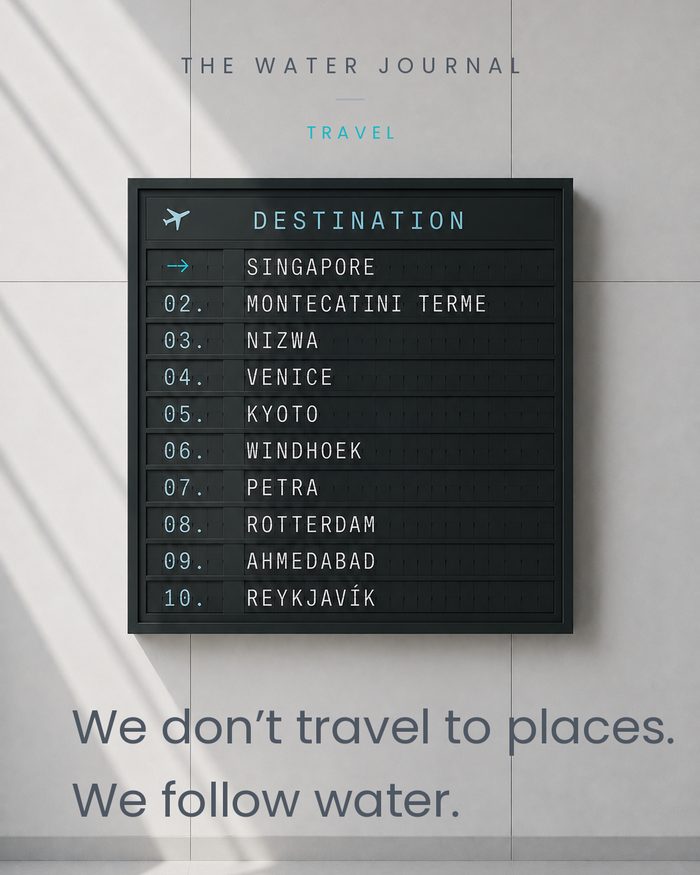
The Closed Loop
Singapore receives roughly four times London's annual rainfall and is still counted among the most water-stressed countries on Earth. The reason is not the sky. It is the size of the island — and what a city has to become when it cannot afford to let anything drain away.
The city does not look thirsty
This is the first thing to understand about visiting Singapore as a water story: nothing about the place performs scarcity. Water is everywhere as decoration. It runs down the walls of hotel atriums, pools under the airport waterfall, fills the canal in front of the Supertrees, sits in a reservoir in the middle of downtown where a tourist can hire a kayak. Taps are drinkable. Nothing is rationed. There is no visible sign of a country that spent its first decades of independence treating water as a matter of national survival.
The absence of a visible problem is the achievement. Everything a traveller walks past — the drains, the canal edges, the barrage across the mouth of the bay, the plant behind the fence at Changi — belongs to a single system, and the system is designed to make its own difficulty disappear. This is a guide to seeing it anyway.
It helps to know the date the whole thing is organised around. Singapore imports raw water from the Malaysian state of Johor under an agreement signed in 1962, and that agreement expires in 2061. A country cannot renegotiate rainfall, so it spent sixty years building a system that could reduce its dependence on imported water — and make 2061 a horizon rather than a crisis. That system is what a visitor is actually walking through.
The arithmetic of an island
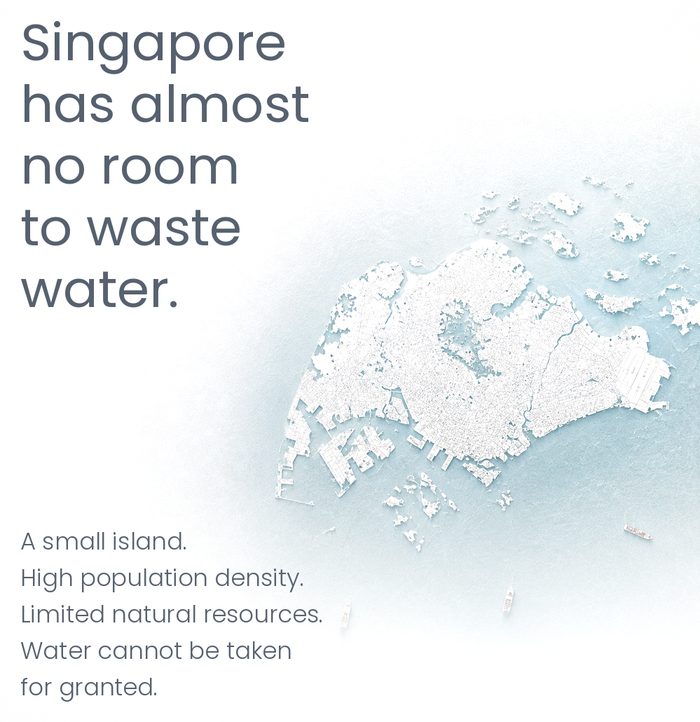
Singapore gets around 2,400 millimetres of rain a year — roughly four times London's. What it does not have is anywhere to put it. There are no large rivers, no aquifers worth the name, no mountain snowpack, and only about 730 square kilometres of land, most of it built on.
The clearest way to state the position is per person. FAO data put Singapore's renewable water resources at just 105 cubic metres per person per year in 2017 — a figure that belongs in the same table as desert states. It is one measure of the underlying constraint. Other water-stress indices, using different definitions of locally available supply and demand, also place Singapore among highly stressed countries — even though the reliability of the water it actually delivers is exceptionally high.
The city is the catchment
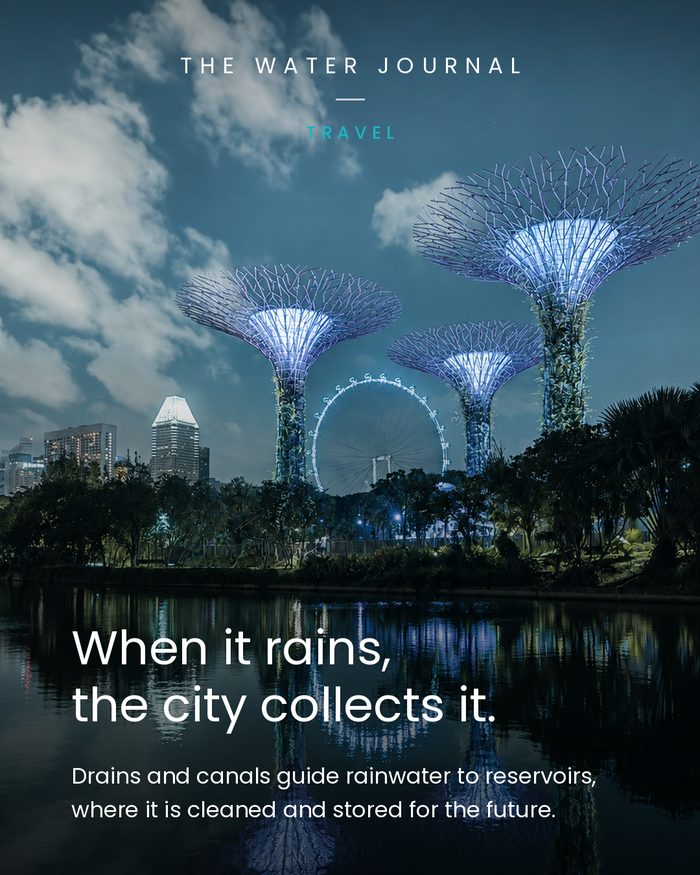
The response was to stop distinguishing between the city and the watershed. Two-thirds of Singapore's land surface is now designated water catchment, feeding seventeen reservoirs through a network of drains and canals. Rain that falls on a car park in Toa Payoh is not waste water. It is inventory.
That decision has consequences most visitors never connect to water. If the streets are the first stage of the drinking-water supply, then littering, illegal discharge and unmaintained drains are not aesthetic issues; they are contamination of a reservoir. Singapore's famous attention to clean streets and drains is therefore more than aesthetic: it helps protect the quality of the water entering the catchment before treatment begins.
Four taps and a deadline
PUB, the national water agency, organises supply as four sources it calls the Four National Taps: water from local catchment, water imported from Malaysia, desalinated seawater, and NEWater — treated used water put back through microfiltration, reverse osmosis and ultraviolet disinfection.
Drawn as a diagram it is a loop rather than a line. Rain falls on the city, is collected in drains and reservoirs, treated, distributed, used, collected again as used water, reclaimed, and returned. Imported and desalinated water enter from the side as top-ups. Nothing in the sequence is unusual on its own. What is unusual is that one national agency oversees the water cycle as an integrated whole.
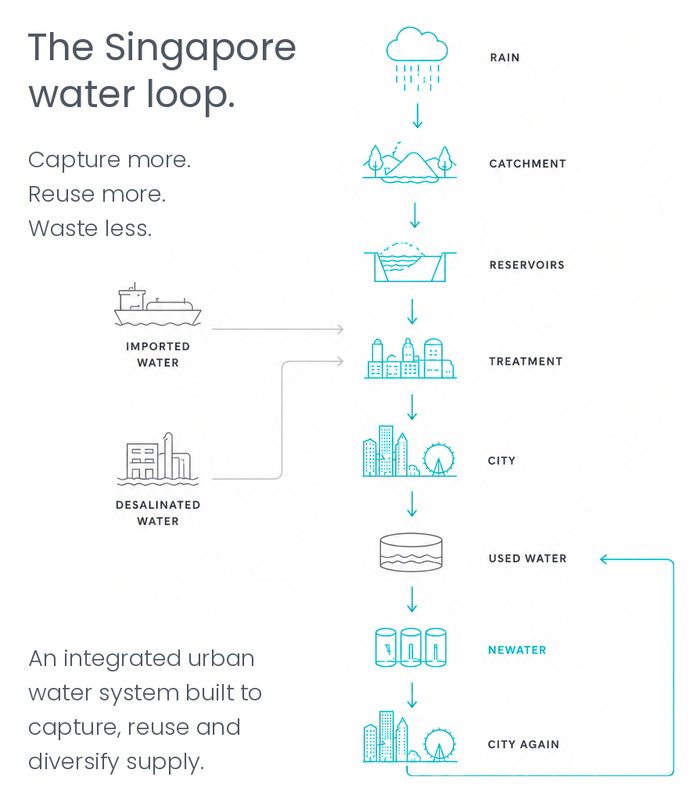
The naming was part of the engineering. Reclaimed water can be a hard sell; presenting it as NEWater, a product with a brand and a visitor centre, was a deliberate act of public persuasion. The name was paired with an unusually deliberate public-education campaign, helping turn reclaimed water into an accepted part of Singapore's supply strategy.
The imported tap is the one with a clock on it. Under the 1962 Water Agreement, Singapore may draw up to 250 million gallons of raw water a day from the Johor River, and supplies Johor with treated water in return. That agreement expires in 2061. An earlier one lapsed in 2011. The 2061 expiry has become one of the strategic horizons against which Singapore has built its long-term water resilience.
NEWater is the tap that answers it. Publicly launched in 2002, it entered full-scale production with the opening of the first two plants in 2003. PUB has stated that NEWater capacity can meet up to about 40% of current-scale demand, and its published long-term planning target has been up to 55% by 2060. Most of it goes to industry — wafer fabrication, electronics, cooling systems — which is the part usually left out of the story. A smaller share is blended into reservoirs and treated again before it reaches a tap. Desalination, now produced across five plants, can provide up to about 30%.
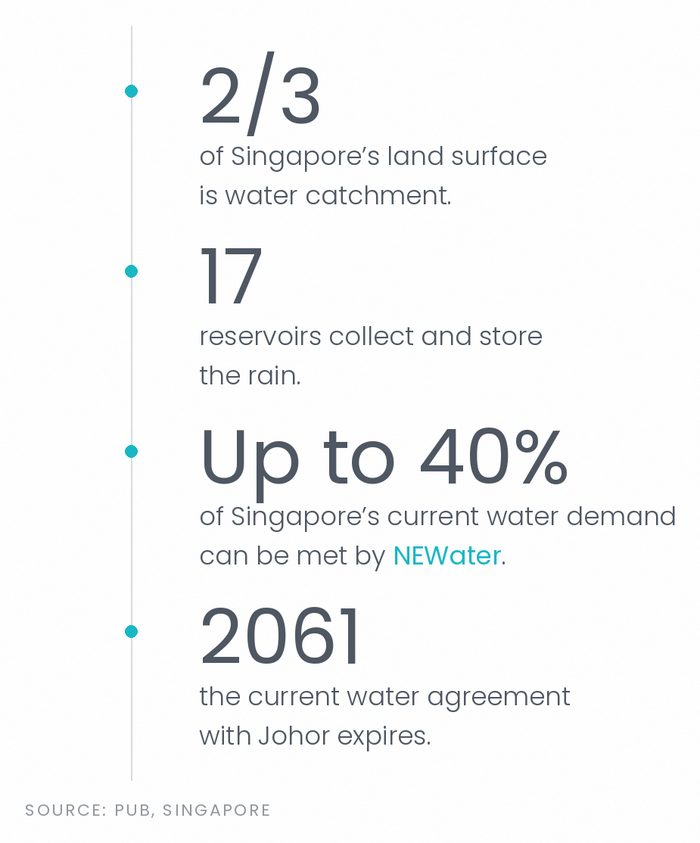
The 40% is production capacity measured against current demand — not the share of a household tap that has been through reclamation.
Together the two weather-independent taps carry a published planning target of around 85% of demand by 2060. That is the strategy in one sentence: make 2061 a deadline, not a cliff edge.
The place where you can stand on it
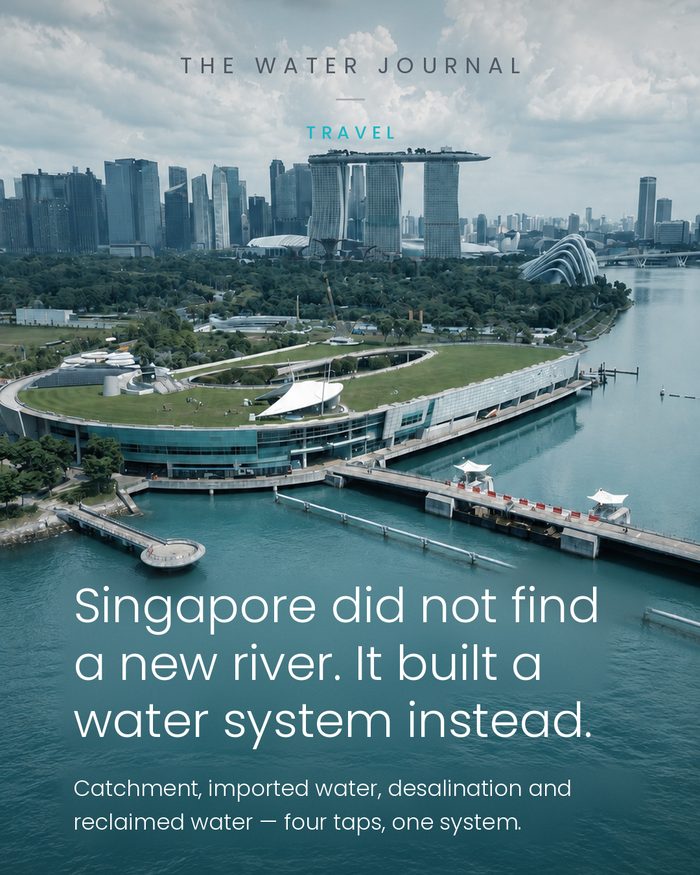
If the system has an address, this is it. Marina Barrage was built across the 350-metre mouth of the Marina Channel and opened on 31 October 2008, closing off a tidal basin at the foot of the financial district. Rain flushed the salt out over the following months; in November 2010 the water behind it was commissioned as Singapore's fifteenth reservoir, and the first inside the city.
Its catchment covers 10,000 hectares — about a sixth of the island, and the most densely built catchment in the country. It does three jobs at once. It keeps seawater out. It holds the reservoir at a steady level, which is why the water in front of the skyline never looks tidal. And when a storm coincides with high tide, nine crest gates and a bank of pumps push stormwater out to sea, which is the reason Chinatown and Geylang flood less than they used to.
It is also, deliberately, a park. Families fly kites on the roof. That combination — flood defence, water supply and public space in one structure — is one of the clearest transferable ideas in Singapore's water story.
What travels, and what doesn't
The temptation is to treat all of this as a template. Some of it is. Demand management here is unusually serious. Household consumption was 141 litres per person per day in 2023, against a national target of 130 by 2030. Singapore has also reported unaccounted-for water at around 5% — a low figure for a large urban network. Neither requires a membrane. Both require metering, maintenance and the political will to price and enforce.
The rest travels less easily. Singapore is a wealthy city-state with one national agency overseeing the water cycle as an integrated whole, from the drain outside a shophouse to the discharge pipe at sea. Its recycled and desalinated taps run on electricity — desalination has been quoted at around 3.5 kilowatt-hours per cubic metre — so water security here is partly an energy problem in disguise. And demand is not settling: PUB expects total demand to almost double by 2065, with industry taking about 60% of it.
None of which is visible from a hotel window. The traveller's version of this story is smaller and more useful: in a city built on the assumption that water cannot be taken for granted, water is treated as something with a cost attached at every point where it is touched — in fittings, in pricing, in what gets built next to a drain. That habit is not tropical, and it does not require Singapore-scale membrane infrastructure to adopt.
How to see it in a day
Start at Marina Barrage, on foot, at the water level rather than the roof — the gates and the pump house are the whole argument in concrete. Cross to Gardens by the Bay and look past the Supertrees to the lakes and planted wetlands: runoff from the Gardens is captured by the lake system, cleansed by aquatic plants and discharged into Marina Reservoir.
Then go inland to one of the restored waterways, where a concrete storm drain has been rebuilt as a river with a floodplain and a park around it. Kallang River at Bishan is the demonstration piece. It is the same policy as the barrage, run in reverse: instead of engineering water away from the city, engineering the city to make room for it.
Finish anywhere with a tap. In a country with very limited natural freshwater storage, the least remarkable-looking object in the room is the one that took sixty years to make reliable.
Singapore did not find a new river. It learned to capture more, reuse more, and lose less.
Sources and notes
01 — The system
PUB, Singapore's National Water Agency, "Singapore's Water Loop" and "Four National Taps." — demand of about 440 million gallons a day; demand projected to almost double by 2065, non-domestic share about 60%; NEWater capacity equivalent to up to 40% of demand, target up to 55% by 2060; desalination up to about 30%.
Ministry of Sustainability and the Environment (Singapore), "Water." — 1962 Water Agreement entitles Singapore to draw up to 250 million gallons of raw water a day from the Johor River, with treated water supplied to Johor in return; expires 2061. NEWater introduced 2002, three-step treatment, within WHO drinking-water guidelines. Household consumption 141 litres per capita per day (2019 and 2023).
PUB, "Desalinated Water." — five operating desalination plants: SingSpring (2005), Tuas South (2013), Tuas (2018), Keppel Marina East (2020) and Jurong Island (2022); desalination planned to meet up to about 30% of future demand.
PUB, "Marina Barrage." — opened 31 October 2008 across the 350-metre Marina Channel; 10,000-hectare catchment; nine crest gates and drainage pumps; Marina Reservoir commissioned as a freshwater reservoir on 20 November 2010, Singapore's fifteenth.
02 — The context
FAO AQUASTAT, via the SDG 6 country profile for Singapore. — internal renewable freshwater resources of about 105 m³ per capita; long-term average annual precipitation of about 2,500 mm.
C40 Cities, "Singapore: Marina Barrage." — two-thirds of land area as water catchment; rainwater stored in seventeen reservoirs; catchment raised from half to two-thirds with the Marina, Punggol and Serangoon reservoirs.
World Resources Institute, Aqueduct Water Risk Atlas. — places Singapore in the highest band of baseline water stress, on a withdrawal-to-supply definition.
Gardens by the Bay, "Sustainability Efforts," and National Parks Board, "Managing water quality in Gardens by the Bay." — the Dragonfly and Kingfisher lake system as an extension of Marina Reservoir; runoff cleansed by aquatic plants and filter beds before discharge.
A. K. Biswas and C. Tortajada, "Water crisis and water wars: myths and realities," International Journal of Water Resources Development, vol. 35, no. 5 (2019). — domestic use of about 143 litres per capita per day and unaccounted-for water of about 5%; also a critique of how water-stress rankings are constructed.
Note on evidence
The 40% figure for NEWater is production capacity measured against current demand, not the proportion of household tap water that has been reclaimed. Most NEWater is supplied to industry; a smaller volume is blended into reservoirs and treated again before distribution.
Water-stress figures for Singapore depend heavily on definition. WRI's Aqueduct places the country in its highest stress band, while the SDG 6 indicator, computed differently, reports water stress in single-digit percentages. The FAO figure of 105 m³ per person is for 2017. None of these measures describes reliability of delivered supply, which in Singapore is effectively total. The standfirst above reports where these indices place the country, not a judgement of our own.
The 40% and 55% NEWater figures and the 85% combined figure for 2060 are published PUB planning targets stated against demand at the time of publication, not guarantees of a future supply mix. PUB's current projection is that demand may almost double by 2065.
The desalination energy figure of about 3.5 kWh per cubic metre is a figure quoted by PUB for its own plants at the opening of the Tuas Desalination Plant in 2018, not a current system-wide average.
Reservoir and catchment figures are PUB's own published values; percentages of demand shift year to year as capacity is added.
This piece is about how Singapore supplies water. What a Singapore household pays for it is a separate question, computed from PUB's own tariff under a published method, and recorded in the Water Index.